
ICCMM 2026 | University of Colombo

ICCMM 2026 Mini Symposium

Mini Symposium on Computational Ecology and Biodiversity Modelling

Mini Symposium Overview

Sri Lanka is a globally recognized biodiversity hotspot with high levels of endemism across ecosystems ranging from lowland rainforests to montane and dry zone habitats. However, this biological richness is increasingly threatened by land-use change, habitat fragmentation, invasive species, and climate variability.

Computational ecology and biodiversity modelling provide a powerful framework by integrating ecological theory with mathematical modelling, statistical inference, geospatial analysis, and data science. These approaches enable the simulation of ecological processes, prediction of species and ecosystem responses, and support evidence-based conservation planning.

This Mini Symposium aims to highlight the role of computational ecology in addressing environmental challenges while promoting interdisciplinary collaboration among ecologists, mathematicians, data scientists, and geospatial experts.

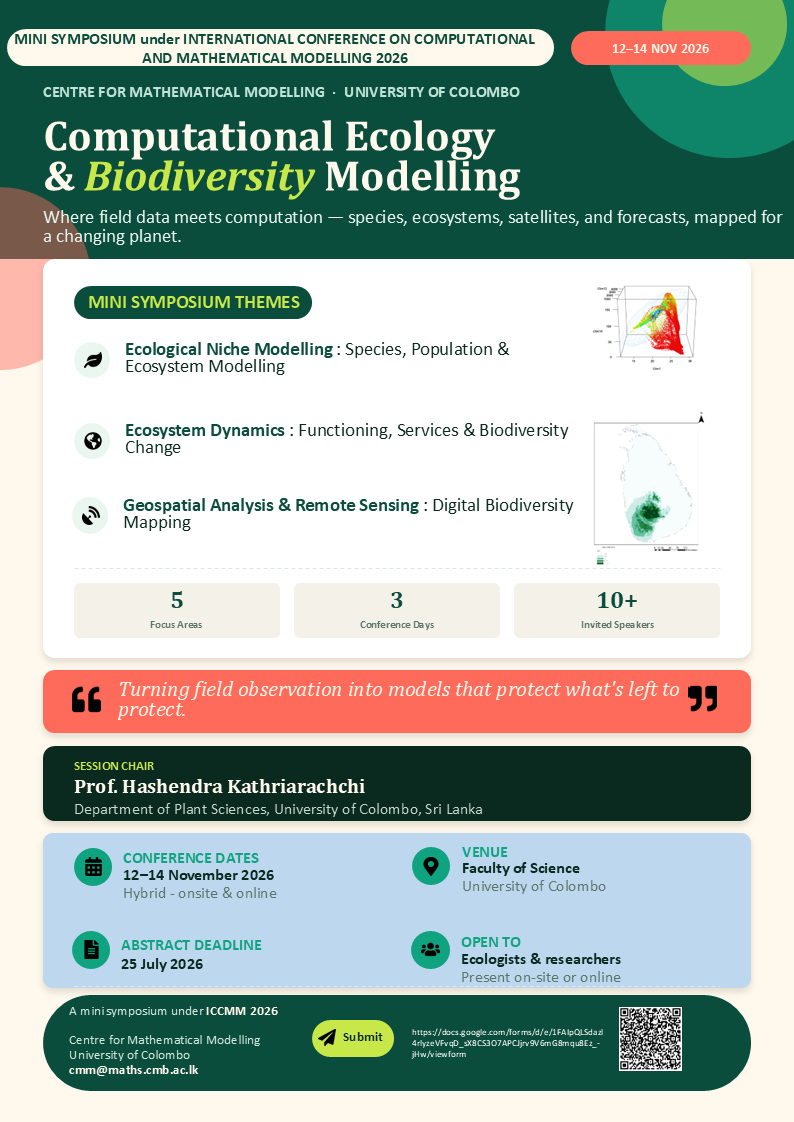
Abstract visualization of computational ecology, biodiversity modelling, geospatial analysis, ecological networks and conservation planning

ICCMM 2026 Mini Symposium Flyer

ICCMM 2026 Mini Symposium

Call for Papers

Computational Ecology and Biodiversity Modelling

For author guidelines, the abstract template, and the submission link, please refer to the main ICCMM 2026 Call for Papers section.

Topics of Interest

Papers are invited on topics including, but not limited to, the following areas:

  • 01
    Species, Population and Ecosystem Modelling Quantitative approaches for modelling species distributions, populations, ecosystems, and ecological responses.
  • 02
    Ecosystem Functioning, Services and Biodiversity Dynamics Modelling ecosystem processes, biodiversity patterns, ecological services, and dynamic environmental interactions.
  • 03
    Geospatial Analysis, Remote Sensing and Digital Biodiversity GIS, remote sensing, spatial analytics, biodiversity informatics, and digital tools for ecological research.
  • 04
    Climate Change, Ecological Responses and Ecological Forecasting Predictive modelling of climate impacts, ecological change, vulnerability, and future biodiversity scenarios.
  • 05
    Biodiversity Data Science, Informatics and Conservation Decision Support Data-driven approaches supporting conservation planning, habitat management, policy, and evidence-based decision-making.
Mini Symposium Chair
Prof. H. S Kathriarachchi
Mini Symposium Secretary
Mr. S. M. Pawuluwage

Further Information Will Be Published Soon

Details about the Mini Symposium on Computational Ecology and Biodiversity Modelling will be updated on this page.